There is no denying the huge influence that competitions have over specialty coffee. Every year, major events – most notably the World Coffee Championships – take place in different countries and bring together some of the industry’s most skilled and talented professionals.
This gives us a lot to celebrate about coffee competitions, particularly the extraordinary level of innovation and creativity they encourage. But that’s not to say that these events haven’t received their fair share of criticism over the past few years, too.
Many point to the lack of inclusivity, diversity, and accessibility at high-level competitions, which can be a huge barrier to entry for some coffee professionals. And unfortunately, this tends to disproportionately affect certain demographics more, including those who work in producing countries.
The International Coffee Organisation estimates that Latin America will account for more than half of global coffee production in the 2023-24 harvest season. Despite this, since 2015, less than ten Latin American roasters have participated in the world finals – a staggeringly small number compared to competitors from Global North countries.
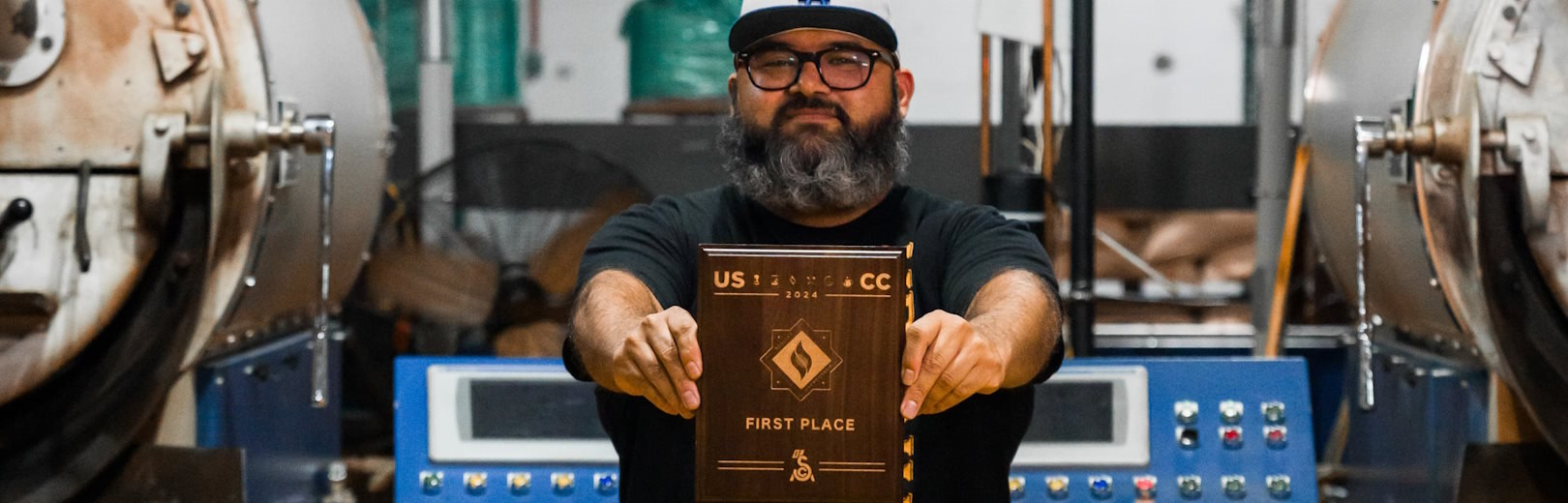
Without better representation of these communities at competitions and beyond, specialty coffee misses out on their wealth of knowledge. To understand why we need to see more Latin Americans taking part in championships, I spoke to Eduardo Choza, Director of Coffee at Mayorga Coffee and the 2024 US Coffee Roasting Champion.
You may also like our article on what competitors need to know about the World Coffee Roasting Championship.

Why coffee competitions have become more popular
It’s been hard to ignore just how prominent coffee competitions have become over the past decade. We have even seen the release of documentaries and films like The Coffee Man, The Road to Milan, and Coffee Wars highlight the hard work and dedication it takes to compete in barista championships – ultimately helping to make these events more mainstream.
There is a growing number of competitions held every year, but the most well-known are the World Coffee Championships. These include:
- World Barista Championship
- World Brewers Cup
- World Coffee Roasting Championship
- World Cup Tasters Championship
- World Latte Art Championship
- World Coffee in Good Spirits Championship
- World Cezve/Ibrik Championship
Prior to the world finals taking place, Specialty Coffee Association chapters host competitions in a wide range of countries to determine national champions. These winners then go on to represent their country on the global stage and vie for the title of world’s best.
Although barista competitions always remain a favourite, roasting championships have certainly become more popular over the past couple of years, too – especially the World Coffee Roasting Championship (WCRC).
The event is split into three stages:
- Pre-roasting – which includes green coffee evaluation, sample roasting, open cupping, and roast planning for both a single origin coffee and a blend
- Production roasting – competitors have 30 minutes to roast the single origin coffee and an hour for the blend
- Production roast evaluation – the judges cup and score all roasted coffees to determine a winner
Essentially, the WCRC is designed to assess roasters’ green grading, production roasting, and sensory analysis skills, as well as their ability to develop blends and coffee knowledge. This means roasters need to understand exactly what the judges are looking for, and how they can develop roast profiles to best highlight a coffee’s desirable characteristics.

Is there a lack of representation at coffee competitions?
Participation in coffee competitions has exploded in recent years, with events becoming bigger and bigger with each edition. For instance, at the inaugural 2013 WCRC in Nice, France, there were only ten competitors from nine different countries, albeit mainly from Asia and Europe.
Fast forward to the 2023 edition and competitors represented five continents and 20 different countries, four of which were producing ones (Thailand, Brazil, Mexico, and Indonesia).
The World Coffee Roasting Championship is an international competition, and should therefore represent a diverse and broad range of industry professionals from around the world. While significant progress has clearly been made, unfortunately, some demographics aren’t represented as much as others.
Take Latin America for example. Compared to countries like the US, UK, Australia, South Korea, and Norway, very few Latin American roasters have had the chance to display their skills and expertise on the global stage.
Understanding the issues
So why is there little representation of Latino coffee professionals, especially when they have such a crucial role in the global coffee industry?
Eduardo Choza is the Director of Coffee at Mayorga Coffee – the largest exclusively organic roaster in the US that works closely with Latin American producers to empower them and their communities. He is also the 2024 US Coffee Roasting Champion, and is the only Latino to win the competition in the last decade. Eduardo represented the US at the World Coffee Roasting Championship in Copenhagen, Denmark from 27 to 29 June 2024.
“Competing requires a significant amount of resources,” he tells me. “Money and time are major investments, and the inability to afford both can limit access and lead to the exclusion of a lot of talented people.
“A lack of access to information or knowing what it takes to compete is another limiting factor,” he adds. “Unless you know someone who has competed, it’s hard to find information or videos about roasting championships in particular, which is why I’m open to helping anyone who wants to take part.”
Eduardo does, however, acknowledge that representation at competitions is slowly improving.
“When I started to compete in 2019, there was a very noticeable lack of diversity in the US Coffee Championships,” he says. “As the years have progressed, we’re now seeing a wider range of people and demographics represented.”

The growing number of Latin Americans at coffee competitions
Underrepresentation of any demographic in the coffee industry – including Latin Americans – is harmful in a number of ways. But ultimately, it’s a failure to recognise the integral role that the Latino community plays in specialty coffee.
In addition to producing some of the world’s best arabica, Latin Americans also have a long standing coffee-drinking culture. According to the National Coffee Association’s 2023 National Coffee Data Trends report, 63% of Latinos had consumed specialty coffee in the past week – the highest of any demographic in the US.
Circling back to representation at competitions, the first-ever Latin Americans to take part in the World Coffee Championships was at the 2003 World Barista Championship, when baristas from Mexico, Puerto Rico, and Colombia took to the global stage.
At the 2011 WBC in Bogotá, Colombia, we saw El Salvador’s Alejandro Mendez become the first-ever Latin American World Barista Champion – a significant milestone for Latinos in coffee. Ten years later, Colombian Diego Campos also earned the title of world’s best barista.
The 2023 World Coffee Championships were also notable for the same reason. Brazil’s Boram Um placed first at the World Barista Championship, while Carlos Medina became the first-ever Latin American to win the World Brewers Cup.
Why diversity and inclusivity are so important
Eduardo explains why better representation of Latinos is essential for people in the community.
“You want to see people who look like you on a national stage,” he says. “When competitions lacked diversity on both ends (i.e. competitors and judges), it was difficult for me to feel comfortable.
“At the 2024 US Coffee Roasting Championship qualifiers, there were only five Latinos out of 32 people, and only two of us qualified for the finals,” he adds. “I was the only Latino who competed in the final round as the other Latino roaster unfortunately had to defer his position.”
Just like in any other industry, if certain demographics or communities don’t see themselves represented more openly at coffee competitions, there is often little incentive to seek support or guidance to take part.
“Other Latino roasters have reached out to me to feel more motivated to compete,” Eduardo explains. “Knowing someone who has taken part in these events before can be very encouraging, but it’s about more than that. When I see my culture represented, it makes me feel a sense of comfort and belonging. It’s important to see ourselves be successful, and to have people we can look up to that resemble us and our upbringing.”

The future of coffee championships needs to be diverse
In the years to come, coffee competitions will continue to grow and evolve. A big part of this needs to be better representation of Latin American professionals on the global stage.
Coffee has deep social, cultural, and economic significance in many Latin American countries. In Colombia, for instance, approximately 10% of the population has a direct or indirect relationship with the coffee industry, which accounts for about 5.3 million Colombians.
As specialty coffee consumption also grows in Central and South America, local and national competitions will keep becoming more and more popular – which means we’re likely to see more Latinos secure spots in the world finals.
“I think seeing more Latino competitors invigorates and encourages others in the US and Latin American producing countries,” Eduardo says. “When I saw Dulce Barrera compete at the World Cup Tasters Championship a few years ago, I felt empowered and encouraged to keep working hard.
“There are a lot more Latino competitors in the US championships now,” he adds. “For the most part, we all know and root for each other, too. And in the coming years, there will only be more Latin American competitors that can teach the next wave of young coffee professionals.”
Shining more of a spotlight on producers
At the 2024 World Coffee Roasting Championship, Eduardo represented the US and showcased not only his Latino heritage, but also his community’s deep rooted coffee traditions and knowledge. For Eduardo, a key part of this is highlighting the producers that he works closely with at Mayorga Coffee.
“Engaging directly with producers and focusing on the human element of coffee is very special to me, and one of my favourite things about being a part of Mayorga Coffee,” he explains. “Knowing who we work with and having a relationship with them gives me a huge sense of pride and responsibility.
“We put more care and intention in our products because we owe it to the people who produce them,” he adds. “One thing that was really impactful prior to competing was receiving videos with words of encouragement and support from our friends at origin.
“When my name was announced as the winner of the 2024 US Coffee Roasting Championship, thinking of those messages and all the people that have supported my coffee career along the way made that moment even more emotional and special,” he continues.

Specialty coffee prides itself on being diverse and inclusive. But to truly achieve this, we need to work harder to improve representation of marginalised communities.
Competitions can be a particularly useful tool for this. By seeing more Latinos showcase excellence on the global stage, other Latin American coffee professionals can feel empowered to also take part – pushing the industry forward in more positive ways.
Enjoyed this? Then read our article on why Latino representation is so important in specialty coffee.
Photo credits: Mayorga Coffee, Specialty Coffee Association, World Coffee Events
Perfect Daily Grind
Please note: Mayorga Coffee is a sponsor of Perfect Daily Grind.
Want to read more articles like this? Sign up for our newsletter!